
What Does Drywall Finishing Include?

Updated: Aug 29
If you have ever looked at newly hung drywall and thought the hard part was over, this is where many projects take a turn. Hanging sheets is only the first step. What does drywall finishing include? It includes the work that turns raw panels with visible seams and fasteners into smooth, uniform walls and ceilings that are ready for texture or paint.
That sounds simple until you see what happens when it is done poorly. Bad finishing leaves ridges, flashing, visible joints, uneven corners, and patches that stand out the second light hits the wall. Good finishing makes the surface look clean, straight, and consistent. For homeowners, that means a better-looking room. For commercial property owners and project managers, it means fewer callbacks, fewer delays, and a finished space that actually looks professional.
What does drywall finishing include on a real job?
In practical terms, drywall finishing usually starts after the drywall has been installed and properly fastened. The finisher is not just covering seams. The goal is to hide all transitions between panels, conceal screw or nail heads, reinforce joints and corners, and create a surface that meets the intended finish level.
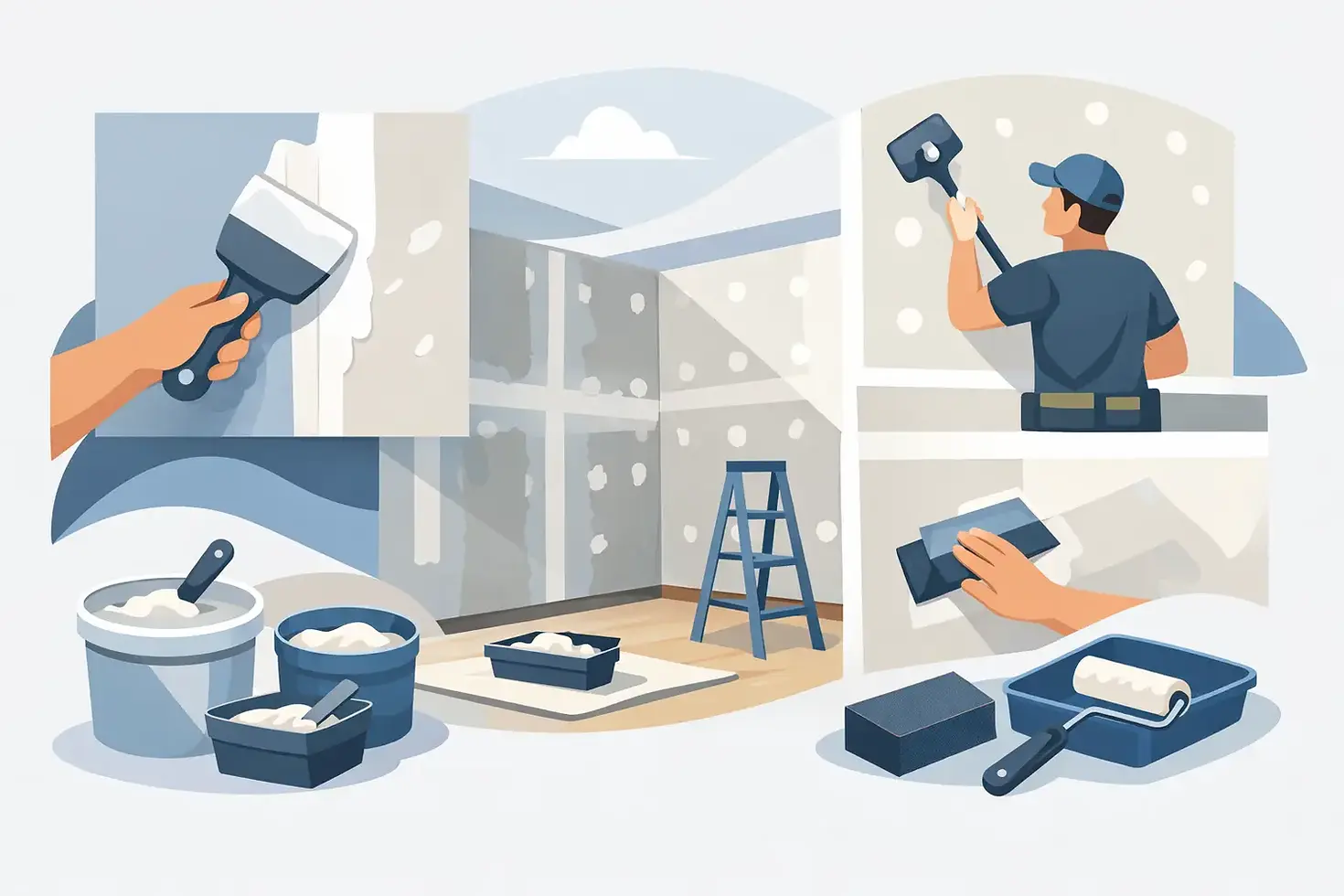
That typically includes taping the joints, applying multiple coats of joint compound, finishing inside and outside corners, covering fasteners, sanding the surface, and preparing the drywall for texture or paint. Depending on the project, it may also include patch blending, texture matching, skim coating, and final touch-up work before painting begins.
The exact scope depends on the condition of the drywall, the type of room, the lighting, and the final finish expected. A basement remodel, office buildout, garage conversion, and restaurant interior may all need drywall finishing, but they do not always require the same level of detail.
The core steps in drywall finishing
The first major step is joint taping. Seams between drywall sheets are covered with joint compound and reinforced with tape, usually paper tape or mesh tape depending on the application. This step matters because the tape helps prevent cracks from showing along panel joints over time.
After the tape is set, additional coats of joint compound are applied. This is often called mudding. The finisher builds out the seam gradually, feathering each coat wider so the transition disappears into the face of the wall. This usually takes more than one coat because one heavy pass tends to shrink, crack, or leave a visible hump.
Fastener heads also get covered during this stage. Every screw indentation has to be filled and smoothed so it does not telegraph through paint later. On a larger room or commercial space, that can mean hundreds or even thousands of fastener spots.
Corners are another key part of the job. Inside corners are taped and finished so they look sharp and clean. Outside corners typically use corner bead, which gets mudded over and shaped to create a straight, durable edge. If corner work is sloppy, it stands out immediately.
Then comes sanding and surface correction. Once the compound dries, high spots, lap marks, and rough areas are sanded down. A good finisher is not just trying to make the wall smooth by feel. They are making sure the wall will still look smooth after primer, paint, and direct light expose every flaw.
Why multiple coats matter
One of the biggest misunderstandings about drywall finishing is the idea that it can be rushed. It usually cannot. Joint compound needs time to dry between coats, and each coat serves a different purpose.
The first coat locks in the tape and starts filling the joint. The next coats widen and flatten the area so the seam disappears. Final coats handle cleanup, refinement, and appearance. Skip a coat or rush the drying process, and the wall may look acceptable at first but fail under paint.
This is where experience matters. A dependable contractor knows how much material to apply, how to avoid overbuilding seams, and when conditions on site are slowing dry time. Humidity, temperature, and airflow all affect the schedule.
Finish levels are part of the answer
When people ask what does drywall finishing include, the honest answer often depends on the finish level required. Not every project calls for the same standard.
Lower-level finishes may be acceptable in utility rooms, unfinished storage areas, or spaces that will be hidden behind tile or heavy texture. Higher-level finishes are needed in living rooms, offices, retail spaces, and areas with strong lighting or smooth paint.
A level 4 finish is common for many painted walls. A level 5 finish goes further and often includes a skim coat across the full surface for the most uniform appearance. That added step is especially useful where critical lighting will expose imperfections, such as long hallways, open commercial interiors, and rooms with large windows.
This is one reason pricing can vary. Two jobs may have the same square footage, but the labor is not equal if one needs a higher finish level or extra correction work.
Repairs and patchwork are different from new finishing
Drywall finishing on a new installation is usually more predictable than repair work. Repairs often involve matching existing wall texture, blending old and new surfaces, and dealing with framing movement, moisture damage, or previous bad patch jobs.
For example, if a ceiling has a water-damaged cutout, finishing the repair means more than closing the opening. The patched section has to be taped, mudded, sanded, and often textured to match the surrounding ceiling. If the texture is off, the repair remains visible even if the surface is technically smooth.
That is where a one-stop contractor has an advantage. If the same company can handle framing correction, drywall replacement, finishing, and painting, the final result is usually cleaner and the process is easier for the customer.
Texture, skim coating, and paint prep
Drywall finishing does not always stop at smooth seams. On many projects, the next step is texture application. That may involve orange peel, knockdown, hand texture, or matching an older finish in part of the house or building. Texture has to be consistent in pattern and density, or the patch will stand out.
Skim coating is another service that often falls under drywall finishing. This is a thin layer of compound spread across a broader area or an entire wall to smooth out rough surfaces, old texture, minor imperfections, or inconsistent repairs. It is more labor-intensive, but it can completely change the look of a room.
Paint prep also matters. A finished drywall surface should be clean, uniform, and ready for primer. If sanding dust, tool marks, or uneven compound remain, painting will not hide them. In many cases, paint actually makes the flaws more obvious.
What drywall finishing should not include
It helps to be clear about scope. Drywall finishing is not the same as drywall hanging, insulation installation, framing, or painting, although those services often go hand in hand. Some contractors separate them. Others handle the entire sequence.
That distinction matters when you ask for a quote. If you are comparing bids, make sure you know whether the price includes only tape and mud work or also includes hanging drywall, corner bead, texture, primer prep, or final painting. A low number on paper can become an expensive change order later.
Signs the job is being done right
A properly finished drywall job looks boring in the best possible way. Seams disappear. Corners are straight. Wall surfaces look even under normal light and close inspection. Texture matches where it should match, and paint goes on without exposing obvious defects.
You should not see bulging joints, cracked corners, flashing around patches, or screw pops right after completion. Minor touch-ups can happen on any job, especially after primer reveals a small imperfection, but repeated visible flaws usually point to rushed or inexperienced work.
For residential remodels and commercial interiors alike, dependable drywall finishing protects the rest of the project. Cabinets, trim, paint, lighting, and final walkthroughs all benefit when the wall surfaces are handled correctly from the start.
Why the contractor matters as much as the material
Joint compound, tape, and corner bead are standard materials. The difference is in how they are used. Drywall finishing is a labor skill, and it shows. An experienced crew knows how to keep lines straight, manage drying times, reduce sanding mess, and hit the finish level the job actually requires.
That is especially important on remodels, basement finishing, and occupied properties where timing and coordination matter. If one contractor can move from framing to drywall to finishing to paint-ready prep without handing the project off three different times, the work tends to stay on track and the final result is more consistent.
If you are planning a project and asking what does drywall finishing include, the right answer is not just tape, mud, and sanding. It is the full process of making your walls and ceilings look complete, clean, and ready for the next step. If you want that done right the first time, it pays to have a contractor who treats finishing like the visible final product it is, not just another line item on the estimate.
Related services and next steps: Complete Basement Finishing • Commercial Drywall & Metal Framing • Request an Estimate


Comments